
Prepared: A Manual

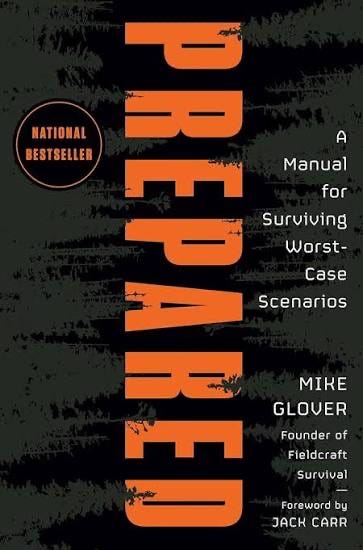
This is a shameless plug for my book, Prepared: A Manual for Surviving Worst-Case Scenarios.
It’s a national bestseller, and I’m reminded of it because I just sat down with Andy Stumpf for an episode of the Cleared Hot podcast that will be released in a couple of weeks. During that conversation, we talked about preparedness, mindset, and why this subject continues to matter more today than ever before.
One of the questions I get asked more than any other is this:
“How do I convince my spouse or significant other that being prepared isn’t crazy?”
The truth is, that’s one of the biggest reasons I wrote Prepared in the first place.
I wanted to remove the stigma from preparedness by replacing fear with facts.
Preparedness isn’t about hiding in a bunker waiting for the apocalypse. It’s about accepting a simple reality: bad things happen to ordinary people every single day.
One of the phrases people associate with me is, “No one’s coming to save you.”
Whether I coined it or not, I know I’ve been saying it for years. I even had it printed on T-shirts long before it became a popular slogan.
It isn’t meant to sound cynical. It’s meant to encourage responsibility.
We’ve built our lives around systems that usually work. You turn on the faucet and expect clean water. You flip a switch and expect the lights to come on. You call 911 and expect police officers, firefighters, or paramedics to arrive within minutes.
Most of the time they do.
But not always.
Over the last several years we’ve seen countless examples where those systems either failed completely or simply couldn’t respond fast enough.
When seconds count, emergency responders are often minutes away.
That isn’t a criticism of the men and women who wear the badge or respond in an ambulance. I’ve worked alongside those professionals my entire career, and they do extraordinary work under difficult circumstances.
It’s simply a reminder that there is always a gap between the emergency and the arrival of help.
Sometimes that gap is measured in minutes.
Sometimes it’s measured in hours.
Sometimes help never comes.
One example that stood out to me was during the unrest in Seattle, when city leadership instructed law enforcement to dramatically limit the calls they would respond to, prioritizing only the most catastrophic incidents.
Whether you agreed with those political decisions isn’t really the point.
The lesson is.
A politician you’ve never met can make a decision that fundamentally changes your expectation of safety overnight.
That’s a sobering thought.
When I pitched Prepared to Penguin Random House, it took nearly two years to convince one of the largest publishers in the world that preparedness wasn’t a fringe topic.
At the time, they believed survival was something only extremists cared about.
Ironically, when the book launched, it sold more copies during release week than the combined sales of the top three nonfiction books on the New York Times Best Seller list.
Yet it never appeared on that list.
Politics has a way of shaping narratives.
I’ve experienced that firsthand throughout my career.
I had my Facebook business account shut down after posting about canning food and preserving supplies.
I lost an Instagram account because I posted a photo of a knife stuck in a log while discussing the importance of carrying a backup blade.
Think about that for a second.
Talking about preserving food or discussing practical tools for self-reliance was considered controversial.
That tells you everything you need to know about the culture surrounding preparedness.
That’s why I’ve always tried to communicate facts instead of fear.
When I transitioned out of military service and began teaching preparedness professionally, I immersed myself in the academic side of survival. I spent years studying survival psychology, disaster response, human behavior, and historical case studies involving both natural and man-made disasters.
One thing became immediately apparent.
There wasn’t much research.
Most people simply don’t want to think about the possibility that one day their life could change forever.
But your worst-case scenario probably isn’t a foreign invasion or a Hollywood-style apocalypse.
Your worst day might be a cancer diagnosis.
A serious car accident.
A natural disaster.
The loss of a loved one.
An economic collapse inside your own household.
Preparedness isn’t about predicting exactly what will happen.
It’s about increasing your ability to respond when something eventually does.
One of the psychologists whose work I studied dedicated his career to answering a simple question:
Why do some people survive while others don’t?
That question fascinated me.
Ultimately, I realized my job wasn’t to guarantee anyone’s survival. Nobody can do that.
My goal is much simpler.
I want to help put people into the category of being more likely to live than die.
Another misconception I hear all the time is that Special Operations soldiers survive because we’re somehow fearless, reckless, or adrenaline addicts.
Nothing could be further from the truth.
The reality is that we survive because we prepare.
People often assume Special Operations is the most dangerous job in the military.
The statistics don’t necessarily support that.
A cook riding security on a logistics convoy can be exposed to extraordinary risk despite never being considered an “operator.”
The difference isn’t courage.
The difference is preparation.
We train relentlessly.
We validate our skills.
We rehearse.
We fail during training so we don’t fail when lives are on the line.
We become stress inoculated.
I’ve jumped from 20,000 feet at night carrying a 120-pound rucksack with my heart rate below 100 beats per minute.
People ask me how that’s possible.
The answer is simple.
Repetition.
Preparation.
Stress inoculation.
Because if I’m operating near my maximum heart rate, I’m not making rational decisions. My critical thinking deteriorates. Emergency procedures become more difficult. Mistakes become more likely.
The same thing happens to anyone experiencing an overwhelming fight, flight, or freeze response.
The question isn’t whether you own a firearm.
The question isn’t whether you have an emergency kit.
The question isn’t even whether you’ve attended a training class.
The real question is whether you’ve validated those skills under realistic conditions.
Can you think under pressure?
Can you solve problems while your heart is racing?
Can you make decisions when your family is depending on you?
Preparedness isn’t a collection of gear.
It’s a mindset.
It’s a lifestyle.
It’s a commitment to becoming more capable tomorrow than you are today.
If none of this resonates with you, that’s okay.
I understand.
Thinking about worst-case scenarios can be uncomfortable.
But ignoring reality has never made anyone safer.
One day, your family’s safety may depend entirely on your ability to act before someone else can.
That’s why I wrote Prepared.
So yes, this is a shameless plug.
If you’re looking for a practical framework that removes the fear, the politics, and the stigma surrounding preparedness, I think you’ll find value in it.
You can grab a copy through the link below, on Amazon, or at your favorite bookstore.
I appreciate the support.
More importantly, I hope it helps you become just a little more prepared for whatever life throws your way.
More than ever-the question is-wouldn’t we be crazy not to be prepared!😎
Loved it!